
The wide supply of E20 petrol in India has triggered a big concern among motor-vehicle owners after many reports suggested that car insurance claims for E20 fuel-related damage in vehicles could be denied, especially if the vehicles are non-compliant to E20-Fuel.
What started the concern for E20 fuel-related damage
The discussion intensified after statements attributed to insurer ICICI Lombard suggested that “if a vehicle suffers damage because it was operated using a fuel not recommended by the manufacturer, insurers could interpret that as improper use or negligence.” This has raised fears among owners of older petrol vehicles that insurance protection might become ineffective if E20 fuel caused mechanical issues to their car.
E20 fuel is a petrol blend containing 20% ethanol and 80% conventional petrol. India has been progressively increasing ethanol blending as part of energy security and emissions reduction goals. E20 availability has expanded significantly across fuel stations.
Why older vehicles became the focus
The concern largely affects cars or vehicles that were not designed or certified for E20 compatibility.
The higher ethanol content in petrol can interact differently with fuel systems because ethanol is highly hygroscopic and it absorbs moisture. That may affect certain components in the fuel system such as rubber, plastic, sealing and other fuel-delivery components if they were not engineered for fuel blends such as E20. This creates a concern primarily around long-term usage wear-and-tear and fuel-system durability rather than immediate engine failure.
Owners of cars or vehicles manufactured before the E20-compatibility standards became common, began questioning whether unavoidable use of E20 fuel could expose them to repair costs and claim disputes.
Further clarification that followed after the initial statement
After the public uproar, ICICI Lombard clarified its position.
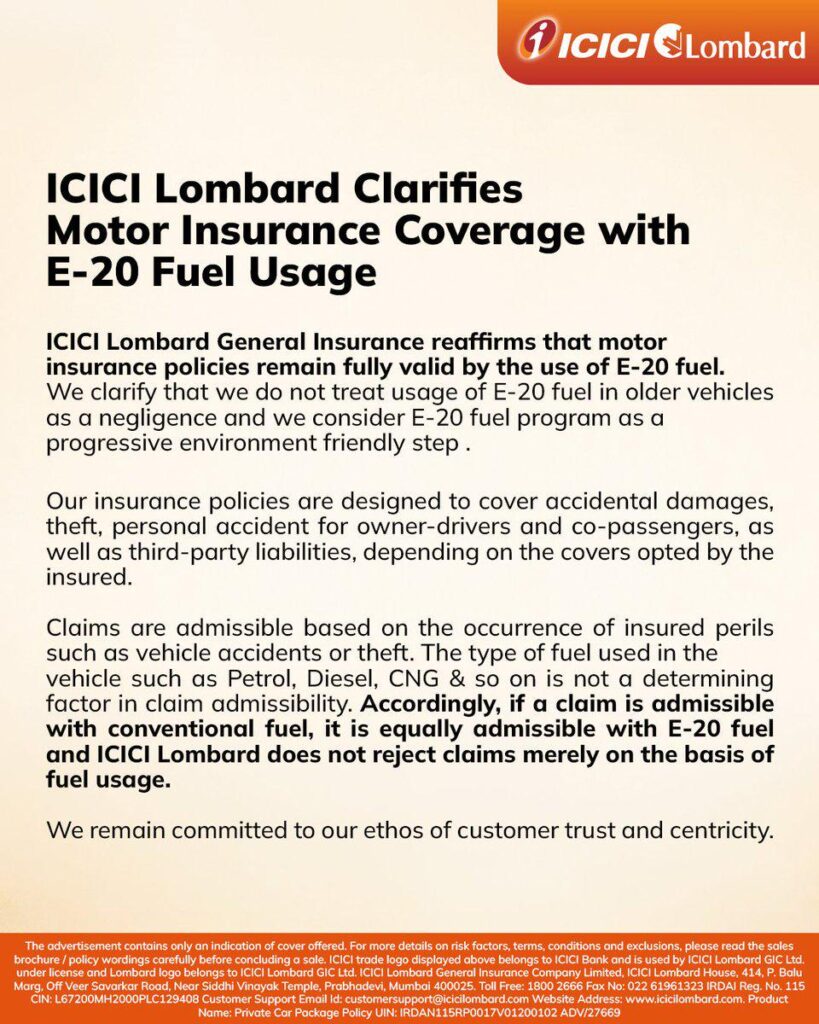
They stated that “motor insurance policies remain valid with E20 fuel usage and that claims are not rejected merely because E20 fuel was used.” The company also clarified that E20-fuel use itself is not automatically treated as negligence during claim assessment.
Separately, India’s Press Information Bureau (PIB) issued a fact-check stating that social media claims suggesting insurance policies become invalid due to E20 use were misleading. According to the government clarification, use of E20 fuel alone does not invalidate motor insurance coverage.
Where do car owners stand?
Even with these clarifications, experts note that insurance outcomes generally depend on the cause of damage and policy wording.
Insurers typically investigate:
- Whether damage is accidental or mechanical.
- Whether there was improper usage.
- Whether manufacturer recommendations were followed.
- Whether exclusions such as consequential damage apply.
That means claim outcomes may still depend on evidence linking the damage directly to maintenance practices or fuel compatibility rather than the simple presence of E20 fuel in the tank.
What car owners should do now
1. Check your owner’s manual for fuel compatibility.
2. Confirm with your vehicle manufacturer whether your model is E20 compatible.
3. Keep service records and fuel receipts.
4. If your insurer raises concerns, request the exact policy clause being applied.
5. Document all repairs and diagnostic findings before accepting claim rejection.
For most owners, the current position is –
using E20 petrol by itself does not cancel insurance coverage — but manufacturer guidance and policy terms still matter if a dispute arises over the cause of vehicle damage.
Pingback: ICICI Lombard Network Hospitals in Vasai-Virar (2026) – Cashless Claim Hospital List
Pingback: ICICI Lombard Network Hospitals in Mumbai – Cashless Claim Hospital List